HATE RADIO: A Play For Our Time
The Marlowsphere Blog (170)

Milo Rau, Playwright of “Hate Radio”
“HATE RADIO”—a play written, produced and directed by Milo Rau, a Swiss theatre director, journalist, playwright, essayist, and lecturer—tells the story of radio station RTLM located in the Rwandan capital of Kigali.
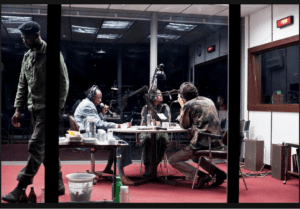
The RTLM Radio Station set in the play “Hate Radio “reenacting a typical broadcast
Launched in 1993 by Hutu radicals, it was listened to by many, young and old with programming that combines pop and folkloric music with “casual” banter. RTLM stands for Radio-Télévision Libre des Milles Collines. This translates to “Free Radio and Television of a Thousand Hills,” a reference to Rwanda’s topography.
In 1994, however, following a deadly attack by Tutsi rebels on the Rwandan president, Juvénal Habyarimana’s plane as it was landing, the Hutu “voices” on radio station RTLM turned their microphones into megaphones of genocide. 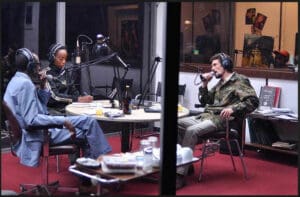 Combining innocuous music with hate talk, repeated references to Tutsis as “cockroaches,” the Hutu voices blatantly encourage their like countrymen and women and children to take up arms, specifically machetes, and kill every Tutsi, moderate Hutu, and Twa they could find—men, women (some pregnant), and children—with no mercy, mutilating this portion of the minority population with impunity and disregard for their humanity. Despite a presence of a United Nations Peacekeeping Force, over a period of four months or so, 600,000 to one million Tutsis, Hutus, and Twa lost their lives.
“HATE RADIO,” however, is not just about a genocide towards the end of the 20th century that the international community apparently did little to stop. It is about radio as a potential force for evil.
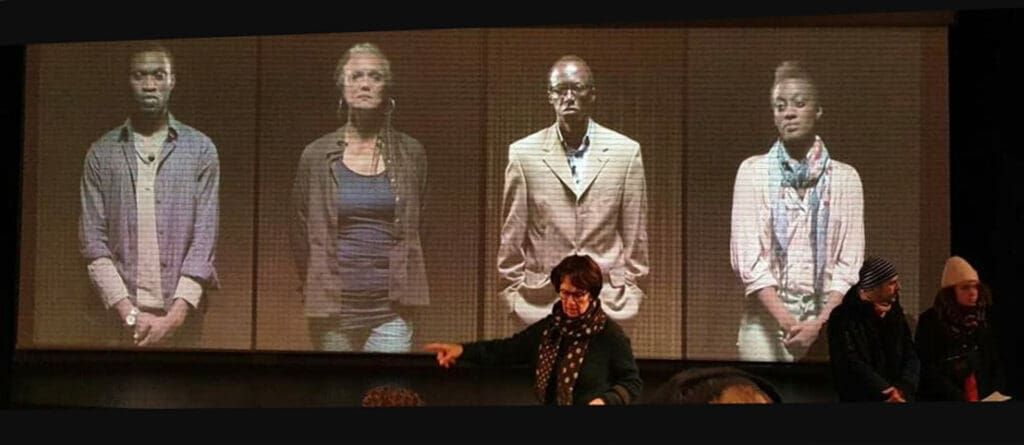
Testimonials projected onto large screens in the play “Hate Radio”
These themes are presented in “Hate Radio” in three parts. At the head and tail of the two-hour show (without intermission) are testimonies presented as large in-person images on screens.
These testimonies include questions from a prosecutor with responses from one of the “voices” from the radio station—a white man, mind you—who came forward after the fact to testify against his fellow “genocide” commentators. Other testimonies include descriptions of the horrors by survivors. At the tail end of the play these same individuals provide what can be described as closure commentaries that reflect on what happened in 1994. There are questions about these events that have no answers.
In the middle of the play is a reenactment of the radio station’s commentators’ broadcast. In terms of staging, this was presented as a reconstruction of what the radio station’s booth looked like, with a sound mixer and DJ in a separate booth, and three commentators in an adjacent booth each with their own microphones situated at a round table. Over the course of what felt like the middle hour of the play, the commentators take turns belittling and demeaning the character of the Tutsi portion of the Rwandan population in no uncertain terms.
What lent authenticity to the play was that all the dialogue was in French. The audience is invited to listen to the play on headphones as a way of immersing everyone in the moment. English translations of the French dialogue appear at the top of the enclosed glass booth that is visible to the audience on two sides.
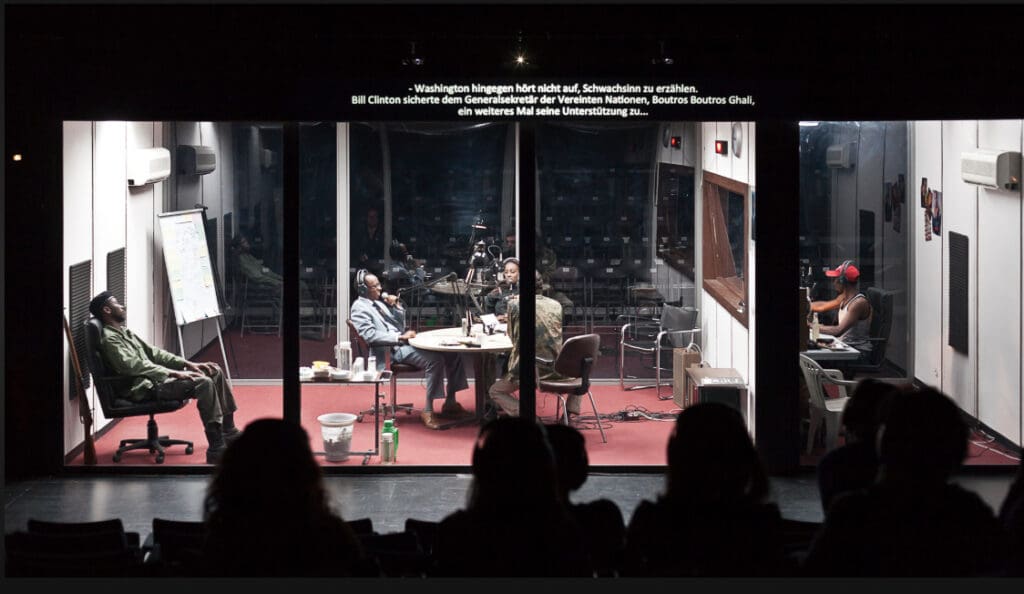
The RTLM Radio Station in the play “Hate Radio” with translations above the booth and audience seated on both sides of the booth.
At first, the commentators appear friendly and jovial. Their repartee gives the audience a sense of camaraderie. Slowly, but surely, though, the comments turn increasingly dark and homicidal. It becomes increasingly clear over the course of this part of the play time how emotionally disconnected the commentators are from their hate speech and what was happening outside their radio booth.
During one section of this middle part of the play, three Hutu listeners call in, including an eight-year old boy who is encouraged to point out Tutsis attempting to flee the carnage.
“HATE RADIO” is a play for our time, any time. The scene is remindful of how the Nazis used radio to propagandize against the Jews and how the Japanese used radio to encourage allied troops to give up during WWII.
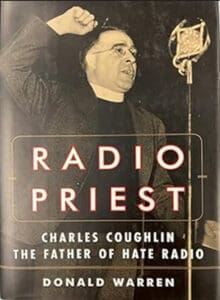 Further, before World War II Father Charles Coughlin, a Canadian-American Catholic priest based near Detroit, the so-called “Radio Priest,” had an estimated 30 million listeners tuned in to his weekly broadcasts. After making attacks on Jewish bankers, Coughlin began to use his radio program Golden Hour to broadcast antisemitic commentary. In the late 1930s, he supported some of the policies of Nazi Germany and Fascist Italy.
In more recent times, radio and television has been used to denigrate minorities and especially immigrants, and to foment anger and violence against certain groups. Media outlets such as FOX News and the Culture Wars radio show are examples. The Internet, moreover, has given voice to a multitude of “hate mongers” targeting every manner of minority, as well as including so-called “white elites” and immigrants who are perceived as suppressing “real Americans.”
While the play certainly brings home the travesty of the Rwandan genocide it does not explain how the radio was able to engage a large part of the population, i.e., Hutus, in murdering without immediate consequence another large part of the Rwandan population, i.e., Tutsis.
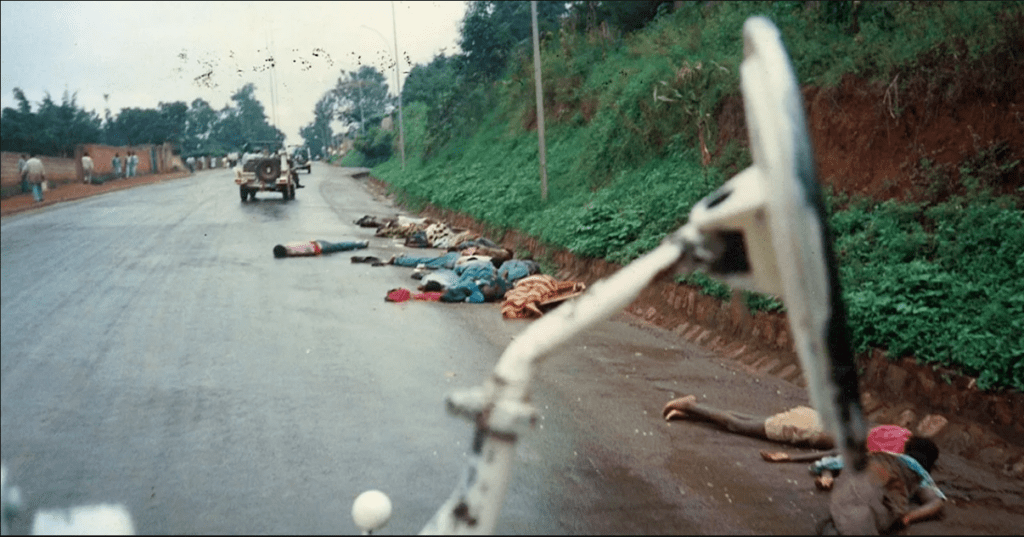
Tutsis killed and left by the side of the road during the Rwandan Genocide
The answer, perhaps, lies in education levels. Before the 1994 genocide the literacy rate in Rwanda was 50%. This means roughly half the population was susceptible to the spoken word, to the human voice. And when those voices, i.e., voices of hate, are heard coming out of a box, i.e., a radio receiver, perhaps miles away from the source of those voices, those sounds must have had the power and authority of a deity. If Rwandan society had had a much higher literacy rate in 1994, might the genocide have been averted? Perhaps not.
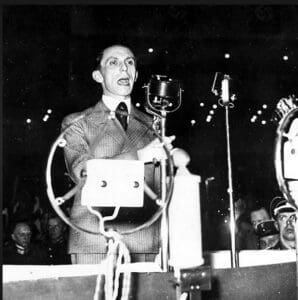
Joseph Goebbels, Hitler’s Propaganda Minister
In the 1930s Herr Joseph Goebbels, Hitler’s propaganda minister, installed radios all over Germany and the medium was used to instill antisemitism in the population. At the time the literacy rate among the populace was 99%! Education in Germany was compulsory. The Holocaust nevertheless ensued.
The only conclusion, therefore, one can come to is that the Hutu population was predisposed to putting down the Tutsi population with extreme prejudice. The radio, in the Rwandan context, was the effective trigger of the genocide.
“HATE RADIO” underscores the power of media, whether print or electronic. The Internet aside, not everyone gets to have a voice on traditional media, such as newspapers, magazines, broadcast radio and television, and cable television.  And when you read, or hear, or see someone in the traditional media those voices, those images carry the mantle of authority. The Internet and social media have now given voice and imagery to any one, the cost of entry is so much lower than traditional media. As a result, voices and images that might have been marginalized in the past now have the opportunity to say whatever they want, including hate speech.
“HATE RADIO” brings that message home. This said, the play undermines its message by overstaying its visit. The first third of play could have been shortened a bit. The descriptions of the travesties are presented with too many pauses and words. The middle section, especially, could have been cut by at least 15-20 minutes. As an audience watching and listening to the play at the St. Ann’s Warehouse in the DUMBO section of Brooklyn, we got the message after 30 minutes of hate speech. Perhaps it was the playwright’s intention: to hold us hostage in terms of time as a way of making us feel the pain more acutely. The lack of an intermission was probably also part of this strategy.
The last section of the play was just right in terms of time and came as a relief, of course, to the tension created.
Another problem for an English-speaking audience was that the translations went by too quickly for a full understanding of the French-spoken content by the radio commentators cum genocide instigators. Less dialogue in the middle section might have helped mitigate this technical challenge.
All in all, though, HATE RADIO is definitely a play for our time and any future time when the media is used to suppress, violently or otherwise, one segment of a population for the sake of another. It’s a waring sign that we all need to remain vigilant about. This current production, though, could well take a lesson from electronic media itself, that in today’s speed of light information-dominant world shorter is better than longer.
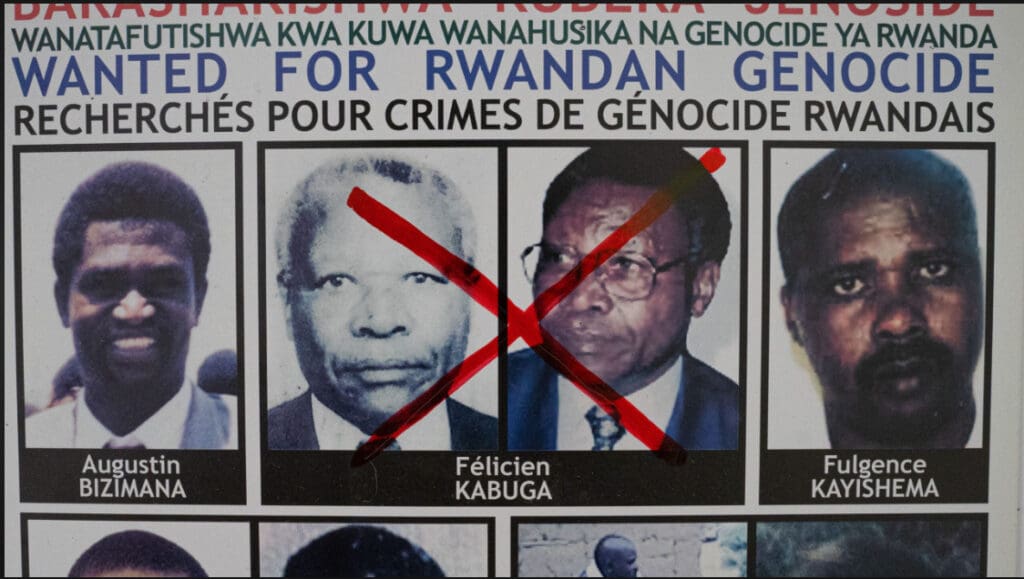
Wanted posters of some of those who incited the hate during the Rwandan Genocide
A Postscript: RTLM was shut down after the genocide. Its founders faced international condemnation after the fact. Too late, though, for the tens of thousands who died.
© Eugene Marlow, Ph.D. 2026