Dianne Reeves & Company Fill The Rose Room @ JALC with Sound, Intimacy, & Humanity
The Marlowsphere Blog (#169)
QUESTION: How do you fill the 1,233-seat Rose Room at Jazz @ Lincoln Center not just with an audience, but also with a sound that befits the room?
ANSWER: On February 14, 2026, Valentine’s Day, JALC saw fit to present five musicians, each of the highest caliber.

Dianne Reeves’ band, T to B: keyboardist, John Beasley, guitarist, Romero Lubambo, bassist, Dezron Douglas, and drummer, Terreon Gully
The evening opened with pianist and keyboardist John Beasley, a composer/arranger who plays with a disarmingly economy of notes. He also happens to be the musical director for UNESCO’s International Jazz Day. Next is Brazilian jazz guitarist extraordinaire Romero Lubambo famous for his guitar adaptation of J.S. Bach’s Prelude in C minor from the First Book of the Well-Tempered Clavier.
The two other sidemen were bassist Dezron Douglas whose opening, solo riff with perfect intonation to start the concert rooted the audience to their seats. He provided that musical promise that the audience was about to experience something wonderful. And then entered drummer Terreon Gully. There are two kinds of jazz drummers: those who perceive their playing is the main attraction and the other instrumentalists are merely ornamentation, and those who play with structure, dynamics, and rhythmic variety. Gully is the latter. He was tasty, tasty, tasty.
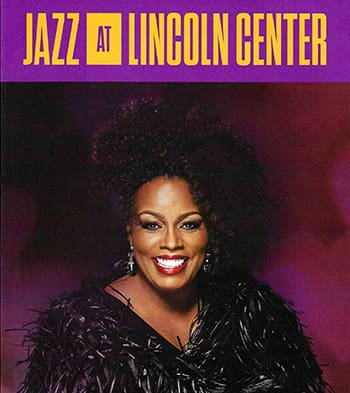
But this quartet was merely musical preamble. The real star of the evening was the vocalist, leader, cum camp counselor, raconteur, improvisor, in charge of the stage and the audience, vocalist Diane Reeves.
There are two categories of jazz vocalists performing on planet Earth today: Diane Reeves, on the one hand, and everyone else on the other. It is not just her enormous vocal range, her effortless ability to scat, to vocalize and improvise with words while telling a story, or her honed-over-decades ability to hold a note at a piano dynamic that impresses.
What struck this audience member on February 14, 2026 evening was the apparent seamless, almost two-hour performance (with no intermission) that moved from one song to another with ease, without pause, from one performance dynamic to another as if Reeves and the other musicians were connected with invisible neurons and synapses.
This was a performance of the highest order. It wasn’t just one song after another with some patter in between. This was a well-rounded, honed, clearly, over years of performance. For example, Reeves and Lubambo have been performing together since the late 1990s. The guitarist is on all of her albums, and it shows. The communication between them is transcendent.

Dr. Billy Taylor
This concert was a master class in structure and choice. I recall having a conversation with Dr. Billy Taylor many years ago about concert structure. The order in which material is presented is just as important as the choice of material itself. Reeves is well aware of this performance requirement.
Her opening lyrics were “What’s New?” from the 1939 song by Johhny Burke and Bob Haggart. It was not just a choice of what has become a jazz standard. This lyric spoke to the audience. It was Reeves’ way of saying “Hello. How are you? Glad to be here this evening with you.” It spoke instantly to the audience and we responded.
Interestingly, Reeves did not perform a series of traditional love songs. Rather she chose songs that were not the usual on the audience’s aural radar. It didn’t matter. What connected Reeves with the audience were her incorporating lyrics such as “. . .this insanity . . .” a not so oblique reference to the divisional politics in America today. At another point in the concert, Ms. Reeves encouraged everyone in the audience to be themselves and to embrace who each of us is as human beings.
Towards the middle of the performance, Reeves excused her bass player and drummer and performed a song with just Beasley (the keyboardist) and Lubambo (the guitarist). After this ballad Beasley left the stage and it was just a duo.
Then it got even more intimate Reeves announced she was approaching her 70th birthday. And then she went on a reflective journey about her own life, period by period, decade by decade starting with when she was just a child. It was personal and revealing. All the while Lubambo strummed a chord cycle in a very Brazilian mode. Her story flowed into a song Reeves had composed inspired by the birth of Lubambo’s first grandchild.
This duet held the stage for almost a third of the concert. It was as intimate and riveting as it could get. And as if a stage manager had called a silent cue, Reeves brought back the balance of her musicians for a finish that included  primarily her telling the story of each of the musicians.
This ended the main performance, but not the concert. An encore was in order and Reeves and Lubambo complied with yet another unfamiliar song. And here’s kicker. While performers of lesser talent and performance acumen end their show by thanking the audience and biding adieu, Reeves left the stage in a far more eloquent and elegant manner.
While singing and Lubambo accompanying, she put down the microphone (you could still hear her) and she walked slowly to the back of the stage to acknowledge the audience members seated there. She then continued to walk while singing until she exited stage right and was gone for the evening. Lubambo completed the chord cycle and he, too, then walked off the stage.
The audience loved it. It was a masterful, seamless performance not soon to be forgotten if at all.
© Eugene Marlow, Ph.D. 2026