
The New York Arabic Chorus Concert: The People, The Community, and Lots of Flowers
Marlowsphere Blog (#171)
The First Unitarian Congregational Society Church on Pierpont Street in Brooklyn Heights (Brooklyn, New York) has a seating capacity of 500: 350 on the main floor, and 150 in the balconies on either side of the sanctuary. On the evening of May 22, 2026 starting at 7 p.m. the pews on the main floor and both balconies were filled to capacity with an audience ready to cheer, applaud, and give the performers a standing ovation before the first note was heard.
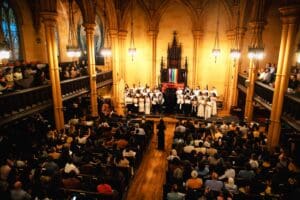
A full house turned out to hear the New York Arabic Chorus at The First Unitarian Congregational Society Church in Brooklyn Heights
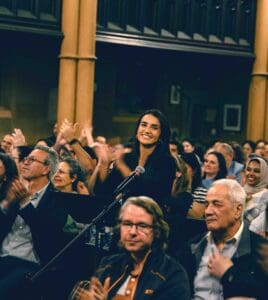
Mona Miari, Artistic Director, New York Arabic Chorus
The occasion was the spring season concert by the New York Arabic Chorus, a one-of-a-kind, 37 voice ensemble led by Arabic music advocate, Palestinian-heritage Mona Miari.
The music aside for a moment, the audience for this concert was primed to engage with the performers from the moment they arrived at the church. The most telling aspect of their enthusiastic disposition was how many came with flowers in hand, not just a few, here and there, but perhaps a good quarter of the audience came with freshly cut bouquets. It was telling. It was supportive. The chorus could have performed one song and stopped—the audience was ready to respond with appreciation, respect and love.
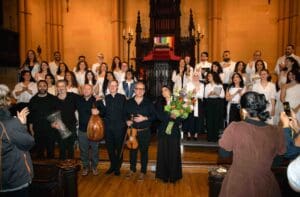
Mona Miari, the Chamber Ensemble and Chorus500
Perhaps we should not be surprised. There are over 200,000 New York City residents of Arabic heritage in New York City. A goodly portion live in the Bay Ridge section of Brooklyn. On Atlantic Avenue, perhaps a half mile from the First Unitarian’s front door, are several Arabic region eateries and shops. Is it any wonder then that a New York City chorus uniquely focused on Arabic vocal music should attract an audience?
Speaking of the concert, this event was mounted by Brooklyn Maqam. Founded in 2018, Brooklyn Maqam is dedicated to celebrating, preserving, and supporting new community-rooted Southwest Asian and North African (SWANA) musical traditions by uniting both established and emerging musicians, music learners, and audiences through affordable and high-quality concerts, informal jams, workshops, classes and innovative musical projects.
The New York Arabic Chorus was founded in 2024 and is therefore relatively new. Regardless, the audience gave its Artistic Director Mona Miari a reception worthy of an Olympic champion. And for good reason.
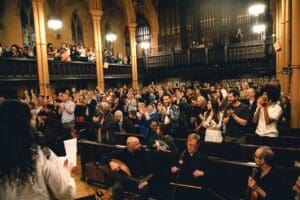
A standing ovation for the New York Arabic Chorus
According to Arab America:
An internationally renowned Palestinian-American artist, singer, and songwriter, Miari is known for her pioneering projects and dedication to elevating Arabic music on the world stage. Raised between Chicago and Palestine and now based in New York City, Mona blends the richness of Palestinian heritage with global influences. Her music embodies both authenticity and evolution, offering a voice that is as grounded in cultural memory as it is expansive in artistic vision.
She is a hero not only of the thousands of years old Arabic music tradition—referred to as maqam—she is also a spokesperson for the Palestinian people.
The two-hour concert was heralded by a five-member chamber ensemble consisting of Sami Abu Shumays (violin), Gideon Forbes (ney) Zafer Tawil (oud), Bashar Farran (bass), and Nezih Antakdi (Percussion). They provided a musical overture that set the musical tone and ear. Arabic music—maqam—does not use harmony (as in Western music), but uses microtonality. These are notes in between the notes of western music.
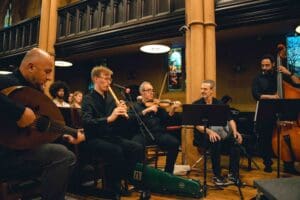
Five-member chamber ensemble consisting of Sami Abu Shumays (violin), Gideon Forbes (ney) Zafer Tawil (oud), Bashar Farran (bass), and Nezih Antakdi (Percussion)
To the western ear these notes and melodies, derived from scales based on microtones, sound sour and perhaps out of tune. To the Arabic ear accustomed to listening to this music from birth it is sounds of home.
And so it did to the packed house. This was an evening of traditional Arabic music attended by an audience with vitality and energy. Even after the concert was over, the street outside was filled with people ready to applaud the chorus members and its artistic director yet again.
© Eugene Marlow, Ph.D. 2026
Photos: Maria Sakr